
The Senate, Blockchain and Defense Supply Chains

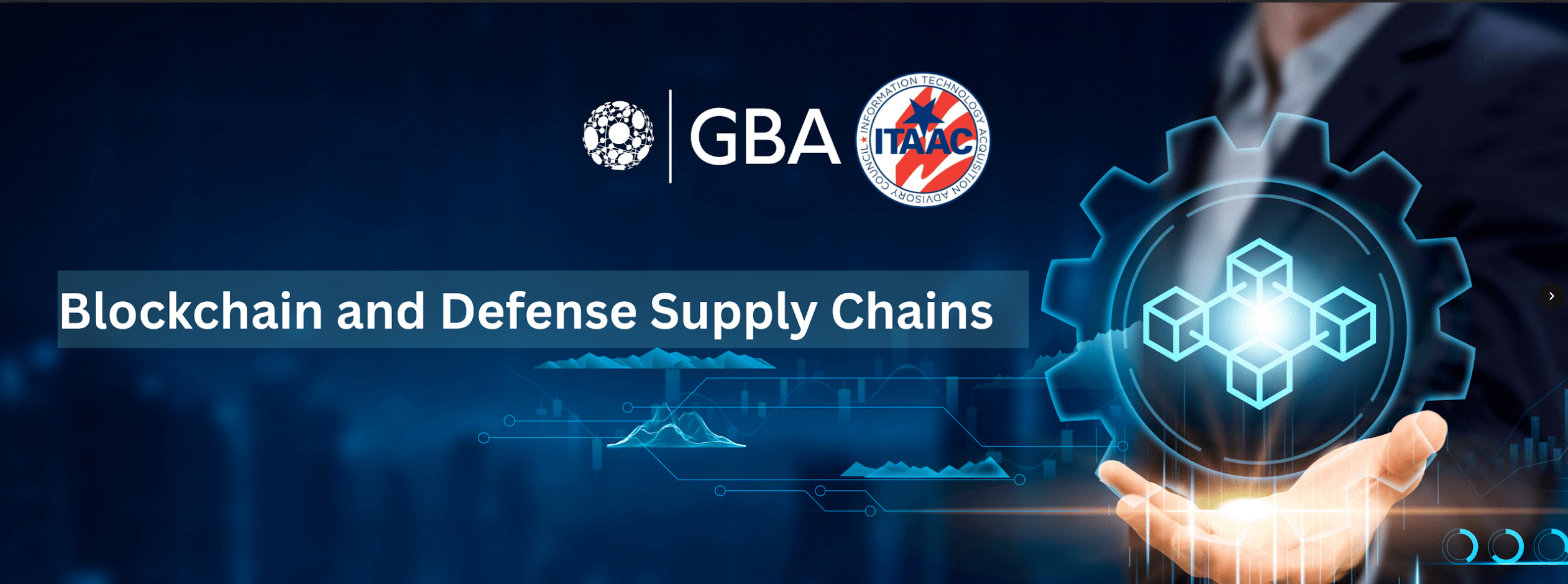
Opinion Editorial by the Information Technology Acquisition Advisory Council and the Government Blockchain Association
A quiet provision in last year’s defense bill could transform how America arms its warfighters — and the clock is ticking.
Lost amid the headlines about defense budgets and geopolitical flashpoints, the Senate Armed Services Committee quietly inserted a provision into its report accompanying the National Defense Authorization Act that deserves far more attention than it has received. In Report 118-188, the committee directed the Secretary of Defense to brief Congress on the potential applications of blockchain technology for supply chain management within the Department of Defense. It is a modest ask. It is also exactly the right one.
The committee’s instincts here are sound. America’s defense supply chain is a sprawling, complex, and increasingly vulnerable ecosystem. From rare earth minerals sourced overseas to semiconductors fabricated across multiple continents, the components that find their way into our weapons systems, vehicles, aircraft, and communications equipment pass through dozens of hands before reaching a warfighter. At every step, data is generated, recorded, transferred — and potentially manipulated. Near-peer competitors like China and Russia have demonstrated both the intent and the capability to corrupt supply chain data, introduce counterfeit components, and exploit gaps in visibility that legacy systems simply cannot close. The Senate is right to be alarmed, and right to be curious about solutions.
Blockchain technology offers a compelling answer to this challenge, and the committee deserves credit for recognizing it.
Trustworthy Data Means Ready Forces
At its core, a blockchain is an immutable, distributed ledger — a record that cannot be altered after the fact without detection. Applied to defense supply chains, this means that every transaction, every handoff, every certification attached to a critical component can be verified with cryptographic certainty. This is not a trivial upgrade. When a maintenance crew chief needs to know whether a part is genuine, when a logistics officer needs to confirm that a shipment has not been tampered with, when a program manager needs to audit the provenance of materials used in a weapons system — trustworthy data is the foundation of every one of those decisions.
Trustworthy data raises confidence. Higher confidence accelerates decisions. Faster, better-informed decisions directly improve supply chain readiness for the warfighter. In a contested environment where speed and reliability are life-or-death variables, that is not an abstraction — it is a strategic advantage.
Connectivity at the Speed of Modern Competition
The defense supply chain does not operate as a single entity. It is a constellation of primes, subcontractors, small manufacturers, logistics providers, and government depots, each operating with its own systems, standards, and data formats. The result is a patchwork of connectivity that is slow, siloed, and riddled with seams that adversaries can exploit.
Blockchain changes that calculus by providing a shared, secure, and collaborative environment that all authorized participants can access in near real time. A distributed ledger does not require a central authority to validate every transaction — the network itself provides that function, continuously and automatically. The result is rapid, secure connectivity that does not sacrifice security for speed. In a world where supply chain disruptions can ground aircraft or delay critical munitions, that kind of seamless integration is not a nice-to-have. It is a necessity.
Revitalizing the Defense Industrial Base
The Senate’s language also points toward a challenge that receives far too little attention: the erosion of the Defense Industrial Base. Decades of consolidation, offshoring, and underinvestment have left the DIB a shadow of what it once was. Small and medium manufacturers — the backbone of specialized defense production — often lack the resources to participate fully in complex, multi-tier supply chains. Communication between DIB companies is fragmented, relationships are difficult to form and maintain, and opportunities that could sustain smaller firms frequently go unrealized.
A blockchain-enabled supply chain infrastructure changes this dynamic dramatically. When every participant in the network — regardless of size — can communicate, transact, and verify on the same trusted platform, the barriers to DIB-to-DIB collaboration collapse. New commercial relationships become possible. Smaller firms gain visibility into opportunities previously reserved for those with deeper pockets and longer relationships. The result is a more resilient, more distributed, and more competitive industrial base — one that is harder to disrupt and more capable of surging production when the nation demands it. That means new economic activity, new partnerships, and critically, new jobs in communities that desperately need them.
The AI Confidence Problem — and Blockchain’s Role in Solving It
There is one more dimension to this story that has received almost no attention in public discourse, and it may be the most consequential of all. The Department of Defense is aggressively investing in artificial intelligence — for logistics, for predictive maintenance, for decision support across virtually every domain of operations. These investments are sound. But AI models are only as good as the data they are trained on and operate from. Garbage in, garbage out is not merely a programming aphorism. In a national security context, it is a vulnerability.
Key decision-makers — commanders, acquisition officials, senior civilian leaders — are understandably cautious about acting on AI-generated recommendations when they cannot be certain the underlying data is clean, complete, and unmanipulated. Blockchain directly addresses this concern. When the data feeding an AI model has been cryptographically verified at every point in its journey, when the ledger recording it is auditable and immutable, confidence in the model’s outputs rises accordingly. Blockchain does not just secure the supply chain — it validates the data environment that makes AI trustworthy enough to act on. In that sense, this provision is not merely a supply chain initiative. It is an investment in the credibility of the Department’s entire data-driven decision architecture.
What Comes Next
The committee’s direction was clear: a briefing by April 1, 2025, covering benefits and risks, the current state of blockchain adoption, a plan for pilot programs, and recommendations for legislative or regulatory action. That deadline has now passed. The question is whether the Department delivered a briefing worthy of the moment — and whether Congress will act on what it heard.
The Senate Armed Services Committee planted an important seed. The defense community, the technology industry, and the public should now demand that it be watered. The supply chains that sustain American military power are too important, too vulnerable, and too consequential to be managed with tools built for a less dangerous world.
The Senate got this one right. Now it is time to build on it.
The IT-Acquisition Advisory Council is a 501(C)6 Standards Consortium with the participation of transformation minded senior leaders from government, academia, industry and public interests. Our mission is to provide Congress, White House, and Executive Branch IT Leadership with a trusted collaborative structure and Transformation Roadmaps for Streamlining the IT Acquisition Process, assuring critical mission elements that are highly dependent on IT (Info Sharing, Cyber-Security, E-Health, E-Gov, E-Biz, and Green IT).
The Government Blockcjain Association (GBA) is a business league promoting the business interests of our members while driving support in the development of ethical and sustainable blockchain solutions and leaders through education, certifications, and developing best practices and standards.


Responses