
IT-AAC & GBA Work Together to Support IT Acquisitions in a Rapidly Changing World

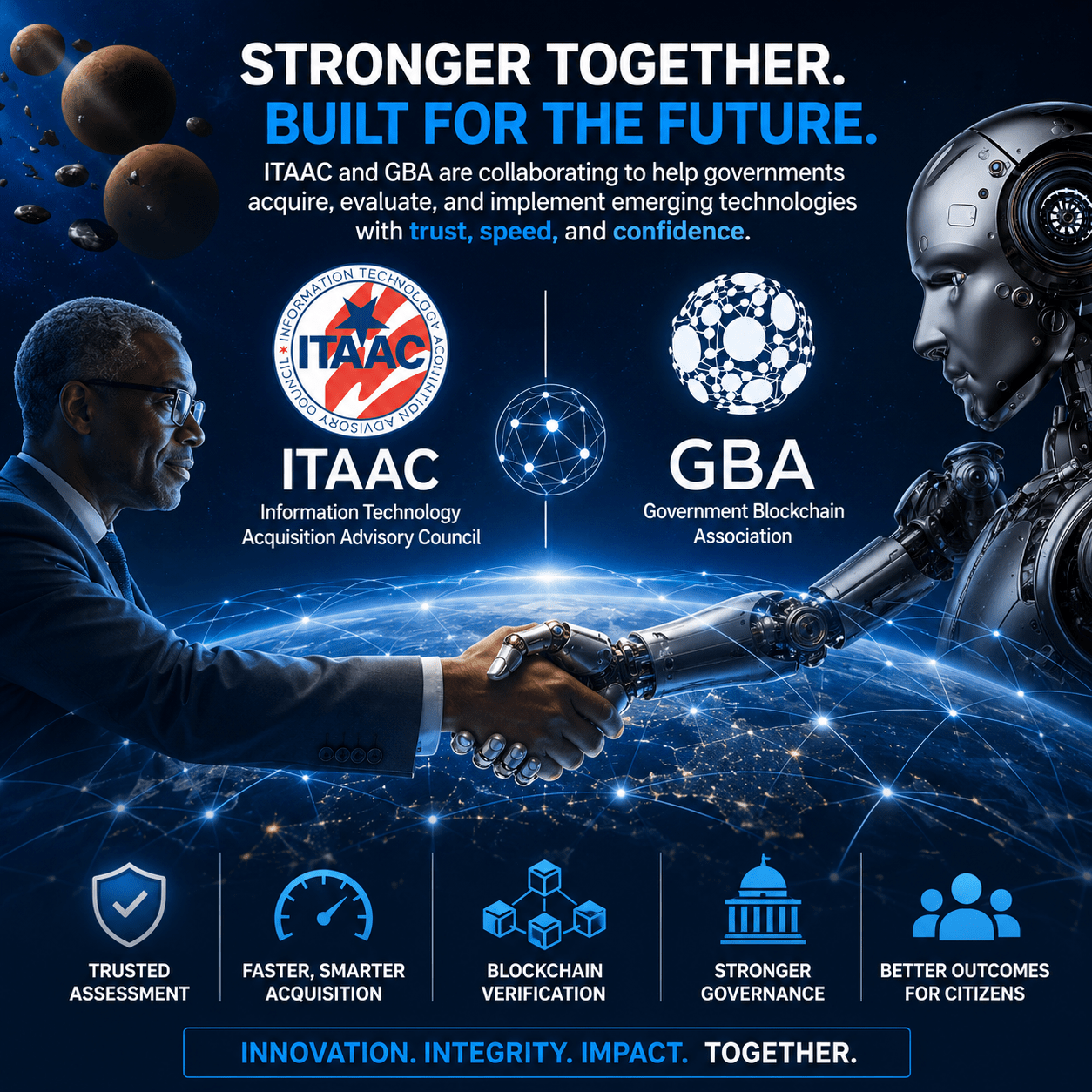
The Government Blockchain Association (GBA) and the IT Acquisition Advisory Council (IT-AAC) have joined forces to collaborate on one of the most urgent challenges facing government today: how to evaluate, acquire, and deploy emerging technologies faster, while maintaining trust, transparency, security, and accountability. Together the GBA and IT-AAC will:
- Establish a joint working group on emerging technology acquisition
- Support online and in-person events, training and
- Develop credentials for IT acquisition officials responsible for evaluating and acquiring advanced technologies.
This Collaboration Comes at a Critical Time
Around the world, governments are recognizing that legacy acquisition models are often too slow for the pace of technological change. Ukraine’s wartime innovation ecosystem offers a powerful example. Facing urgent operational demands, Ukraine has developed faster pathways for moving technology from concept to battlefield deployment. The data speaks for itself. For example, units in Ukraine’s Drone Line initiative were able to order UAVs and other advanced technology equipment through the system, placing orders worth over $417 million in less than two weeks. The lesson is clear: modern government acquisition must become more adaptive, evidence-based, mission-driven, and transparent.
That is Why the GBA / IT-AAC Relationship Matters
IT-AAC brings deep experience in government IT acquisition, modernization methods, acquisition assurance, and public-private collaboration. GBA brings global expertise in blockchain, Web3, digital assets, emerging technology assurance, and the GBA Blockchain Maturity Model as part of the planned credential’s awareness and orientation content.
Together, the two organizations can help government officials answer practical questions such as:
- How should agencies evaluate emerging technologies before procurement?
- How can government buyers distinguish credible solutions from hype?
- How can acquisition officials use market research, assurance frameworks, and performance evidence to reduce risk?
- How can technologies such as blockchain support auditability, provenance, digital identity, procurement transparency, and trusted data exchange?
- How can governments move faster without weakening oversight or public trust?
Ukraine’s experience demonstrates that speed matters. But speed alone is not enough. Rapid acquisition without governance can create duplication, cybersecurity risk, supplier uncertainty, and accountability gaps. The future of public-sector innovation requires both acceleration and assurance.
The GBA–IT-AAC Collaboration is Designed to Support That Balance.
By combining acquisition reform with emerging technology assurance, this relationship can help create practical tools, education, credentials, and working groups that equip public officials to adopt innovation responsibly.
The goal is not simply to promote new technology. The goal is to help governments acquire the right technology, from credible providers, through better processes, with stronger trust mechanisms and measurable mission outcomes.
In an era defined by artificial intelligence, blockchain, digital assets, cyber threats, supply-chain risk, and rapidly evolving public-sector missions, governments cannot rely solely on acquisition models built for a slower age.
The GBA–IT-AAC relationship represents a step toward a more modern approach: faster, smarter, more transparent, and more accountable acquisition of emerging technologies for the public good.
For more information about this collaboration email IT-AAC@GBAglobal.org.





Responses