

Digital Asset Banking Core Achieves BMM Level 4

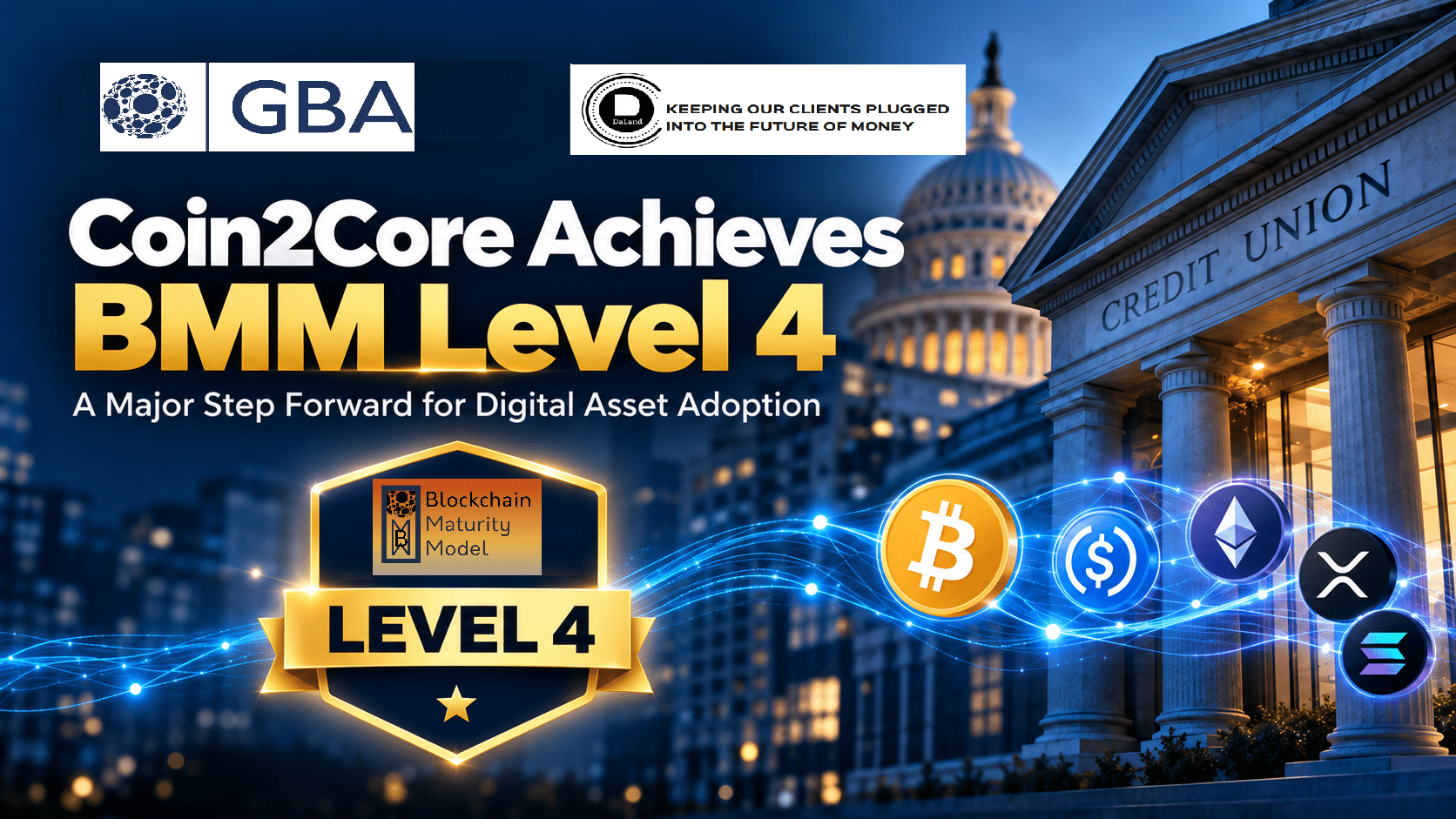
Coin2Core Achieves BMM Level 4
Imagine a credit union member named Maria. She has been with the same credit union for more than a decade. Her paycheck is deposited there. She has a mortgage, a debit card, and a savings account. She trusts the institution because it is familiar, regulated, and accountable. Now imagine Maria becomes interested in digital assets. Today, that often means leaving the financial institution she already trusts, transferring money to an outside platform, opening a new account, learning a different interface, and accepting a completely different set of risks. That disconnect is one of the biggest challenges facing digital asset adoption.
Coin2Core, developed by DaLand CUSO, offers a different model, and its achievement of Blockchain Maturity Model (BMM) Level 4 represents an important step toward making that model real. Keeping the Financial Institution at the Center In a more integrated future, Maria might open the mobile app she already uses for her checking and savings accounts and see digital assets available alongside traditional financial products. She could explore a digital asset, move funds from an existing account, purchase it, and continue interacting with the same financial institution she already knows. From Maria’s perspective, the experience could feel less like “entering crypto” and more like using another financial service offered by her trusted institution.
That difference is enormous. For years, much of the digital asset industry has grown outside traditional banking. Consumers have often had to choose between the familiarity of a regulated institution and access to new forms of digital finance. Solutions such as Coin2Core point toward a future where that choice may no longer be necessary.
That vision sounds compelling, but regulated financial institutions cannot adopt technology based on vision alone. A credit union cannot simply tell its board, regulators, auditors, members, and risk officers that a blockchain solution is innovative. It must demonstrate that the solution is mature enough to operate in a real financial environment.
That is where the Blockchain Maturity Model becomes important. The BMM, developed by the Government Blockchain Association, provides a technology-agnostic framework for assessing the maturity and trustworthiness of blockchain solutions.
BMM Level 4 represents a deployed level of maturity. That means the conversation is no longer limited to whether the technology can work in a demonstration or pilot. It becomes a question of whether it can operate in an environment where it needs to operate as well and as safe as any ohter banking solution. For a regulated financial institution, that distinction is critical.
Now consider the experience from the credit union’s side. Maria sees a convenient digital service. But behind that simple experience are far more complex requirements. The institution must think about cybersecurity. It must think about internal controls. It must think about operational risk, regulatory expectations, business continuity, identity, transaction integrity, and how new technology connects with existing systems. A good customer experience depends on all of those things working together.
That is why maturity matters. The true significance of Coin2Core achieving BMM Level 4 is not simply that another blockchain product has earned a rating. It is that a solution designed to connect regulated financial institutions with digital assets has demonstrated a high degree of maturity within a structured assessment framework. That helps move digital assets from the world of experimentation toward the world of institutional infrastructure.
For many years, the industry has asked whether banks and credit unions would eventually participate meaningfully in digital assets. That question is changing. The more important question now is: “How can they participate responsibly without abandoning the trust, controls, and customer relationships that define regulated financial services? Coin2Core represents one possible answer.
Rather than forcing consumers to leave their financial institutions to participate in the digital economy, it creates the possibility that institutions themselves can become the bridge. That could matter greatly as stablecoins, tokenized deposits, digital securities, real-world assets, and blockchain-based payment and settlement networks become more common.
Maria’s story is hypothetical, but the challenge is real. Millions of consumers already trust banks and credit unions to safeguard their money. If digital assets become a larger part of everyday financial life, those consumers may increasingly expect their trusted institutions to provide access to them. For financial institutions, the opportunity is equally significant. Institutions that can safely integrate new forms of digital finance may be better positioned to maintain customer relationships rather than watching those relationships migrate to outside platforms.
That is what makes Coin2Core’s BMM Level 4 achievement so important. It represents progress toward a financial system where digital assets are not isolated from regulated finance, but integrated into it. And it demonstrates that the next stage of blockchain adoption may not be about replacing traditional financial institutions at all. It may be about giving them the mature, trustworthy infrastructure they need to participate in the digital economy. Coin2Core achieving BMM Level 4 is therefore more than a technical milestone. It is a meaningful step toward a future in which digital assets become a normal, trusted part of regulated financial services.





Responses